
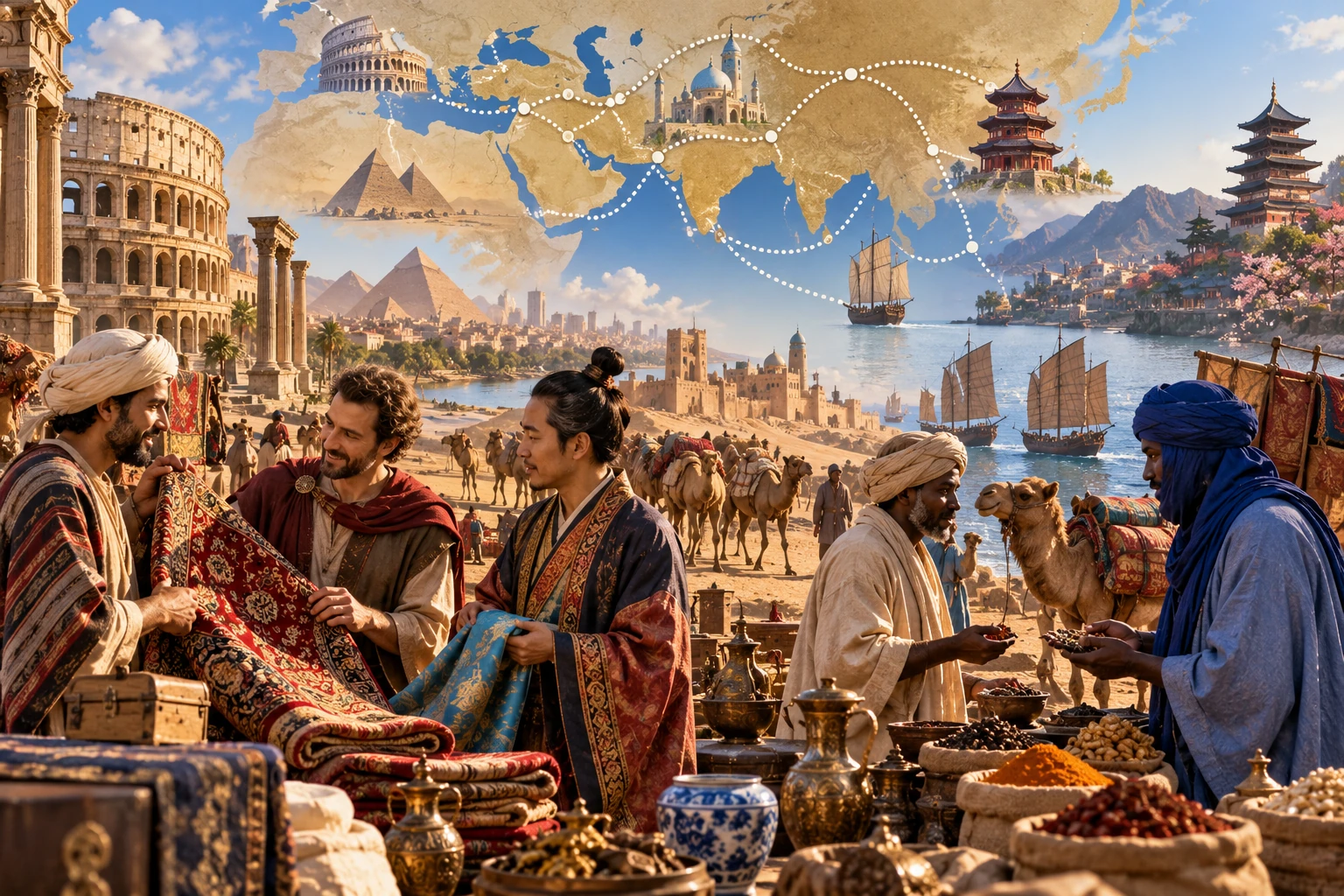
Long before modern highways, cargo ships, and airplanes connected countries around the world, ancient trade routes helped people exchange goods, ideas, technologies, languages, and cultural traditions. Merchants traveled across deserts, mountains, rivers, and seas to reach distant markets. These journeys created connections between civilizations that sometimes existed thousands of kilometers apart.
The Silk Roads and Eurasian Connections
The Silk Roads were among the most important networks of ancient and medieval trade. Rather than being one single road, they consisted of interconnected land and maritime routes linking parts of East Asia, Central Asia, South Asia, the Middle East, and Europe.
Silk was one of the famous products transported along these routes, particularly from China. However, merchants carried many other goods, including spices, textiles, precious metals, ceramics, gemstones, and other valuable commodities.
Cities located along these routes could become important commercial centers because travelers needed places to rest, trade, obtain supplies, and exchange information.
Maritime Trade Across the Indian Ocean
Sea-based trade was another major force connecting civilizations. The Indian Ocean provided a vast network linking East Africa, the Arabian Peninsula, India, Southeast Asia, and other regions.
Merchants used knowledge of seasonal monsoon winds to plan voyages. Ships carried spices, textiles, precious stones, metals, ceramics, and other products between coastal ports.
These maritime connections also encouraged cultural interaction. Port cities became places where people from different linguistic, religious, and cultural backgrounds met and established communities.
The Trans-Saharan Trade Routes
The Sahara Desert might appear to be a barrier between regions, but organized trade networks allowed merchants to cross it. Trans-Saharan trade connected North Africa with communities and kingdoms farther south.
Gold and salt were particularly important commodities. Gold from West African regions was traded northward, while salt and other goods moved south.
Camel caravans made long-distance desert travel more practical because camels could carry substantial loads and survive in harsh conditions with relatively limited water.
Trade contributed to the growth of major West African centers and strengthened connections between North African and sub-Saharan economies.
Trade in the Mediterranean
The Mediterranean Sea served as another major commercial network. Ancient societies including the Greeks, Phoenicians, Egyptians, and Romans participated in extensive maritime trade.
Ships transported agricultural products, wine, olive oil, metals, ceramics, textiles, and other goods between ports.
Trade also encouraged the growth of coastal cities. Ports became important centers where merchants, sailors, craftspeople, and travelers interacted.
Trade Spread Ideas and Technologies
The movement of people and products also enabled the movement of knowledge. Merchants could carry information about farming techniques, navigation, manufacturing, medicine, mathematics, and other subjects.
Technologies and practical knowledge could spread from one region to another through travel and cultural contact. The process was not always immediate, and knowledge was often adapted to local conditions.
Trade networks therefore acted as channels through which innovations could travel across geographic boundaries.
Languages and Cultural Exchange
Commercial contact encouraged linguistic exchange. Merchants often needed to communicate with people who spoke different languages, encouraging the development of multilingual communities and shared commercial terminology.
Cultural practices could also spread through trade. Clothing styles, artistic techniques, foods, religious ideas, and customs traveled alongside merchants.
This cultural exchange helped create societies that incorporated influences from multiple regions.
Growth of Cities and Markets
Trade routes frequently contributed to urban development. Cities located near rivers, coastlines, mountain passes, oases, and crossroads could become important centers of commerce.
Markets brought together producers, merchants, consumers, transporters, and craftsmen. Increased commercial activity could create employment and generate government revenue through taxes and trade duties.
Some cities became famous precisely because of their strategic positions along important trade networks.
Trade and Political Power
Economic connections could influence political relationships. Governments often sought control over important trade routes because commerce could generate wealth and strengthen political institutions.
Rulers sometimes protected merchants and roads, established marketplaces, or built infrastructure to encourage trade. In other cases, competition for valuable routes and resources contributed to conflict.
Trade was therefore closely connected with diplomacy, administration, and political power.
The Human Side of Ancient Trade
Ancient trade also involved challenges. Merchants faced harsh weather, difficult terrain, disease, theft, political instability, and long journeys.
Trade networks could also contribute to the movement of diseases between populations that previously had limited contact. Human migration and forced movement were additional parts of ancient economic systems.
Understanding these complexities provides a more complete picture of how trade affected civilizations.
Lasting Influence
The connections created by ancient trade routes continued to influence later economic and cultural developments. Some historic cities remain important today because of their strategic geographic locations, while modern trade networks often follow routes shaped partly by geography that ancient merchants also had to navigate.
Modern globalization is far more technologically advanced, but its basic principle of connecting distant communities through the movement of goods, people, and information has deep historical roots.
Final Thoughts
Ancient trade routes connected civilizations across enormous distances and helped transform the world beyond the simple exchange of commodities. The Silk Roads, Indian Ocean networks, Trans-Saharan routes, and Mediterranean trade systems created channels for economic activity, cultural exchange, technological knowledge, and human interaction.
